-
This Week’s LGBTSr Humorscope: G is for Gemini

🌈 LGBTSr Weekly Humorscope
“The Stars Are Watching… and They Have Opinions.”
♈ Aries
You are filled with bold ideas this week. Some of them are excellent. Some of them involve rearranging furniture at 9:30 p.m. Pause before lifting anything heavier than your optimism.
♉ Taurus
Comfort is calling your name. Soft blankets. Good snacks. A show you’ve already seen three times. Honestly? The stars support this fully.
♊ Gemini
You will say something “harmless” that somehow launches a 40-minute discussion. Consider whether you want entertainment… or peace.
♋ Cancer
You’re feeling nostalgic. Resist the urge to text that person from 2008. The past is a museum. Visit gently. Don’t move back in.
-
Mark McNease’s Fearsome Fiction Podcast: Night Flight to Murder Town – A Marshall James Thriller (Chapters 4 – 6)

Welcome back to the Fearsome Fiction Podcast. One of my offerings is the weekly serialization of Night Flight to Murder Town: A Marshall James Thriller, book 4. This week Chapters Four through Six take us from the fading shadows of Los Angeles to the restless pulse of New York—and toward a future neither Marshall nor Boo can quite see coming. Marshall says goodbye to a dying friend and the ghosts of his Hollywood past, turns down one last temptation on a city bus, and boards a flight east with more regret than luggage. Years later, settled into marriage and New York life, he finds himself facing a different kind of fear: leaving behind the city that became his identity. Love, loss, survival, and the uneasy sense that life is about to shift again—these chapters mark the end of one era and the trembling beginning of another.
-
MadeMark Publishing to Offer Public Domain Works, Starting with ‘A Marriage Below Zero’ by Alan Dale
This is exciting. As a way to attracted subscribers to my long-running website, lgbtsr.online/, I decided to offer free books of select public domain works. Fiction, nonfition, poetry, more will be revealed.
I’m also publishing them for the general public, as both ebooks and paperbacks.
This month I’ve released a very hidden gem: A Marriage Below Zero, by Alan Dale. It’s one of the earliest published novels to deal with same-sex attraction, narrated by a woman who married a man with a secret life.
A Marriage Below Zero (1889), written by Alan Dale, is a pioneering work of early gay fiction and one of the first English-language novels to center a homosexual male character in a serious, tragic narrative. The story is told from the perspective of Elsie Bouverie, a young woman who enters into what appears to be a promising marriage with the charming and refined Arthur Ravener. At first, their life together seems socially enviable—secure, respectable, and filled with the expectations of Victorian domestic happiness.
But beneath the surface, something is wrong.
Arthur grows emotionally distant, evasive, and restless. Elsie senses that she is not the true object of her husband’s affection. Gradually, she discovers the devastating truth: Arthur is romantically and physically involved with another man. In an era when homosexuality was not only taboo but criminalized, this revelation shatters her understanding of marriage, loyalty, and identity.
Rather than portraying Arthur as a villain, the novel presents him as a man trapped between societal expectations and his authentic self. The “marriage below zero” becomes a metaphor for a union devoid of warmth, passion, and truth—frozen by repression and secrecy. As scandal looms and emotional tensions escalate, the story moves toward a tragic conclusion that reflects the harsh realities faced by gay men in late 19th-century society.
-
This Week’s Fun Facts: Sinking Your Teeth Into Teeth
Medieval “tooth worms” were a real diagnosis.
For centuries, people believed toothaches were caused by tiny worms burrowing inside teeth. Dentists would even try to “smoke them out.” There were no worms, of course. Just cavities doing their thing.People used to reuse other people’s teeth.
In the 1700s and 1800s, dentures were often made from teeth taken from the poor or from soldiers killed in battle. After the Battle of Waterloo, so many teeth were collected they were nicknamed “Waterloo teeth.”Your mouth has more bacteria than there are people on Earth.
Over 700 species can live in your mouth. Most are harmless (even helpful), but don’t invite them to stay by not brushing.The first electric toothbrush appeared in the 1950s.
It was developed in Switzerland and originally designed for patients with limited motor skills.There’s a condition where teeth grow in places they absolutely shouldn’t.
It’s called hyperdontia, and some people grow extra teeth, occasionally even in the roof of the mouth.Cavities are technically contagious.
The bacteria that cause tooth decay can be passed through saliva — sharing utensils, kissing, even blowing on a child’s food. -
Tech Talk: Social Media Without the Stress
By Mark McNease
Facebook, Instagram, and avoiding scams, fake friends, and outrage fatigue
Social media hasn’t felt all that sociable for a long time. What started as a way to share photos and stay in touch can sometimes feel like walking into a wall of noise, outrage, and fake videos, fake images, fake quotes, fake everything. But we can use Facebook, Instagram, and other platforms without completely sacrificing our peace of mind. It just takes a few small adjustments.
First, remember this: we’re in charge of our feeds. On Facebook, we can “unfollow” someone without unfriending them. This can be particularly useful with friends and family we don’t want to alienate by tossing them out the virtual door. By unfollowing them (and, frankly, being unfollowed), we can stay connected but stop seeing posts that raise our blood pressure, sometimes to the point of needing a visit to the nearest Urgent Care. Love you, but I don’t feel like agreeing to disagree right now. Maybe in a month. On Instagram, tapping “Not Interested” teaches the algorithm what we’d rather see. If we engage with travel photos, gardening tips, or grandkid snapshots, we’ll get more of that. Converserly, if we linger on outrage, we’ll get more outrage. The platforms respond to our behavior — so guide them.
-
Savvy Senior: How To Navigate Inheriting an IRA From a Parent
By Jim Miller
Dear Savvy Senior,
What are the rules regarding inherited IRAs? My brother and I recently inherited our father’s IRA when he passed away late last year and would like to know what we need to do to handle it properly.
Oldest Sibling
Dear Oldest,
I’m sorry to hear about the loss of your father, but you’re smart to be planning ahead. Inheriting an IRA from a parent comes with a unique set of rules. Understanding them can help you make the most of the money you inherit and avoid an unpleasant surprise at tax time. Here are some basics you should know.
Setting It Up
Many people assume they can roll an inherited IRA into their own IRA, but that’s not allowed for most beneficiaries. If you inherit an IRA from a parent, sibling, or anyone other than a spouse, you cannot treat the account as your own. Instead, your share must be transferred into a newly established inherited IRA, properly titled in the deceased owner’s name—for example, John Smith, deceased, for the benefit of Jane Smith.
If your father named multiple beneficiaries, the IRA can be split into separate inherited accounts. This allows each beneficiary to manage withdrawals independently, as if they were the sole beneficiary.
You can open an inherited IRA at most banks or brokerage firms, although the simplest option is often to set it up with the firm that already holds your father’s account.
-
Subscriber Exclusive: Free ebook Edition of ‘A Marriage Below Zero’ by Alan Dale
Subscriber exclusive! I’ll be offering one free public domain book each month to LGBTSr subscribers, current and new. If you’re already on board, look for it in the next email. And if you’re new to the place, just SUBSCRIBE HERE for your free epub and PDF versions.
A Marriage Below Zero (1889), written by Alan Dale, is a pioneering work of early gay fiction and one of the first English-language novels to center a homosexual male character in a serious, tragic narrative.
The story is told from the perspective of Elsie Bouverie, a young woman who enters into what appears to be a promising marriage with the charming and refined Arthur Ravener. At first, their life together seems socially enviable—secure, respectable, and filled with the expectations of Victorian domestic happiness.
But beneath the surface, something is wrong.
Arthur grows emotionally distant, evasive, and restless. Elsie senses that she is not the true object of her husband’s affection. Gradually, she discovers the devastating truth: Arthur is romantically and physically involved with another man. In an era when homosexuality was not only taboo but criminalized, this revelation shatters her understanding of marriage, loyalty, and identity.
Rather than portraying Arthur as a villain, the novel presents him as a man trapped between societal expectations and his authentic self. The “marriage below zero” becomes a metaphor for a union devoid of warmth, passion, and truth—frozen by repression and secrecy. As scandal
-
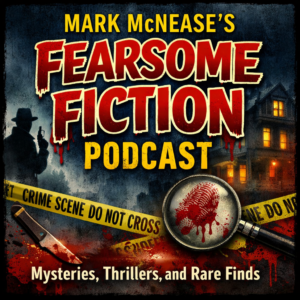
Mark McNease’s Fearsome Fiction Podcast – New Name, Same Great Storytelling: Night Flight to Murder Town – A Marshall James Thriller (Chapters 1 – 3)
Mysteries. Thrillers. Rare Finds.
I’ve renewed, refreshed, and rebranded my fiction podcast, and I’m thrilled to welcome you to the new Mark McNease’s Fearsome Fiction Podcast. Each week I’ll be sharing several chapters of my own harrowing fiction, the kind of stories that creep under your skin and refuse to leave, along with rare and forgotten gems, and select works from other authors whose voices deserve to be heard in the dark.
If you love mysteries with pulse, thrillers with heart, and stories that don’t behave themselves, you’re in exactly the right place.
You can purchase the entire audiobook HERE.
Or listen on Spotify Premium HERE.
This week: Night Flight to Murder Town: A Marshall James Thriller (Chapters 1 – 3)
Marshall James returns in Night Flight to Murder Town, Book 4 in the series. He’s thinking about leaving New York City with his husband for a quieter life, away from the relentless pace of the nation’s largest city. But how did he get here in the first place?
After three stories detailing his harrowing Hollywood past — where lovers, losers, and more than one serial killer nearly ended his life before he could make something of it — Marshall finally tells us how and why he left LaLa Land for Gotham.
This is the origin story beneath the scars. The turning point. The night everything changed.
-
The Twist Podcast 319: Bad Bunny Banger, Travel Packing Tips, Vacation Recap and More
This week on The Twist Podcast with Mark and Rick, we dance to Bad Bunny’s tune, share listener suggestions for travel packing, and catch up with Mark after a whirlwind vacation. Find us on YouTube, Spotify, Amazon Music, and every angel’s top ten playlist.
-
Coming Soon: LGBTSr Subscriber Exclusive – Free Ebooks Starting with Alan Dale’s ‘A Marriage Below Zero’
COMING SOON! THIS TITLE WILL BE AVAILABE IN MARCH
Starting in March, I’ll be publishing ebook editions of public domain books as an exclusive for LGBTSr subscribers. ‘A Marriage Below Zero‘ will be the first, avaiable in March and provided to everyone on our email list. Haven’t subscribed yet? SIGN UP HERE. And note, I’ll be providing many different titles, covering all the letter in the acronum and beyond. Fiction, nonfiction, poetry, it will all be on the LGBTSr bookshelf for our subscribers to enjoy.
About ‘A Marriage Below Zero’
This novel was a true rarity in its time, telling the story of a man married to a woman while maintaining a secret life of loving men.
In late-Victorian London, Elsie Bouverie believes she is stepping into a respectable, secure future when she marries the charming and cultured Arthur Ravener. He is attentive, refined, and socially admired—the sort of husband any young woman would be fortunate to claim. Or so it seems.
But marriage, in this case, is a stage set carefully arranged to conceal a truth that polite society refuses to name.
As whispers begin to surface and Arthur’s affections drift in ways Elsie cannot understand, the young bride finds herself trapped in a relationship defined not by betrayal in the conventional sense, but by something far more destabilizing: invisibility. Arthur’s deepest emotional and romantic attachments lie elsewhere—with men—and his union with Elsie is less a love story than a social shield.
What unfolds is not melodrama, but slow-burn devastation. Dale’s novel—remarkably bold for 1895—peels back the layers of repression, hypocrisy, and coded desire that shaped queer lives at the end of the nineteenth century. Told through confession and reflection, the story exposes the human cost of compulsory marriage and the quiet ruin imposed by a society determined to look away.
A Marriage Below Zero is widely regarded as one of the earliest English-language novels to center explicitly on male same-sex desire. It is at once tragic, restrained, and startlingly modern—a window into a hidden world that refused to stay hidden.