-
A Book Reading with Authors Mark McNease and Kim Cook, Lambertville, May 3 (Video Excerpt)
On May 3rd, 2026, in Lambertville, New Jersey, two authors came together for an afternoon of storytelling, craft, and memoir. Mark McNease shared excerpts from Blank Page to Bookshelf: From First Sentence to First Sale — his guide to fiction writing, character creation, and self-publishing — and Kim Cook shared from her powerful memoir, I Am My Father’s Child: A True Story of History, Mystery, Betrayal, and Forgiveness. Keep watching for a video excerpt from that event.
-
True Crime Tuesdays – A Fearsome Fiction Feature: The Black Dahlia
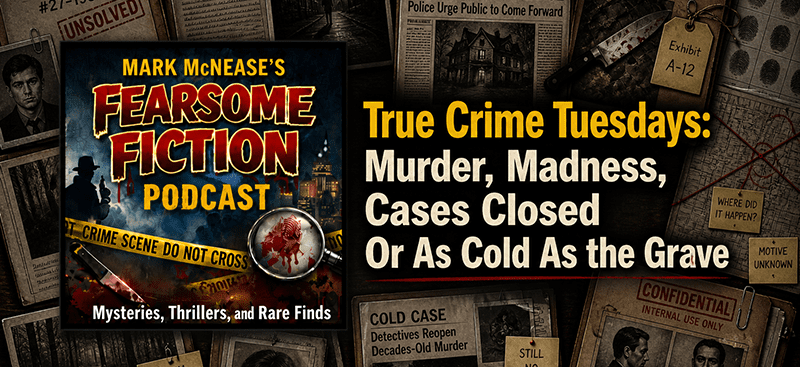
True Crime Tuesdays – A Fearsome Fiction Podcast Feature: The Black Dahlia
Welcome to True Crime Tuesdays. I’ll be sharing a true crime story every Tuesday on Mark McNease’s Fearsome Fiction Podcast. Narration is provided by my own Wondervox. Fasten your headphones for one of the most famous unsolved murders in the annals of American crime – or is it American madness?
They found her on the morning of January 15th, 1947.
A woman walking with her daughter through a vacant lot in the Leimert Park neighborhood of Los Angeles. She thought at first that what she was seeing was a discarded department store mannequin. A broken one, in two pieces.
It wasn’t a mannequin.
The body had been completely severed at the waist. Drained of blood. Cleaned. Posed with a precision that suggested not rage — but ritual. Her face had been slashed at the corners of the mouth, cutting what investigators would describe as a grotesque grin from ear to ear.
She was twenty-two years old. Her name was Elizabeth Short.
The press would call her the Black Dahlia — a name she never knew in life, but one that would outlast everything else about her.
-
Savvy Senior: The Letter Your Loved Ones Will Treasure

By Jim Miller
Dear Savvy Senior,
I want to leave something meaningful for my children and grandchildren, beyond just money or property. I’ve heard about “legacy letters,” but I don’t really know what they are or how to start one. Can you help?
–Legacy Seeker
Dear Seeker,
You’re asking a wonderful question. A legacy letter – sometimes called an ethical will – is a personal note to your loved ones where you can share your values, life lessons, cherished memories, hopes, and guidance. Unlike a traditional will, which focuses on legal matters, a legacy letter comes straight from the heart.
Why write one?
Many people think a legacy is just money or property. But often, it’s your words, values, and life lessons that leave the deepest mark. A legacy letter gives your family something to hold onto – your stories, your traditions, and the experiences that shaped who you are. Children and grandchildren often return to these letters for comfort, guidance, or inspiration long after you’re gone. In many ways, it becomes an emotional last will and testament, answering some of the most important questions about your life.
-
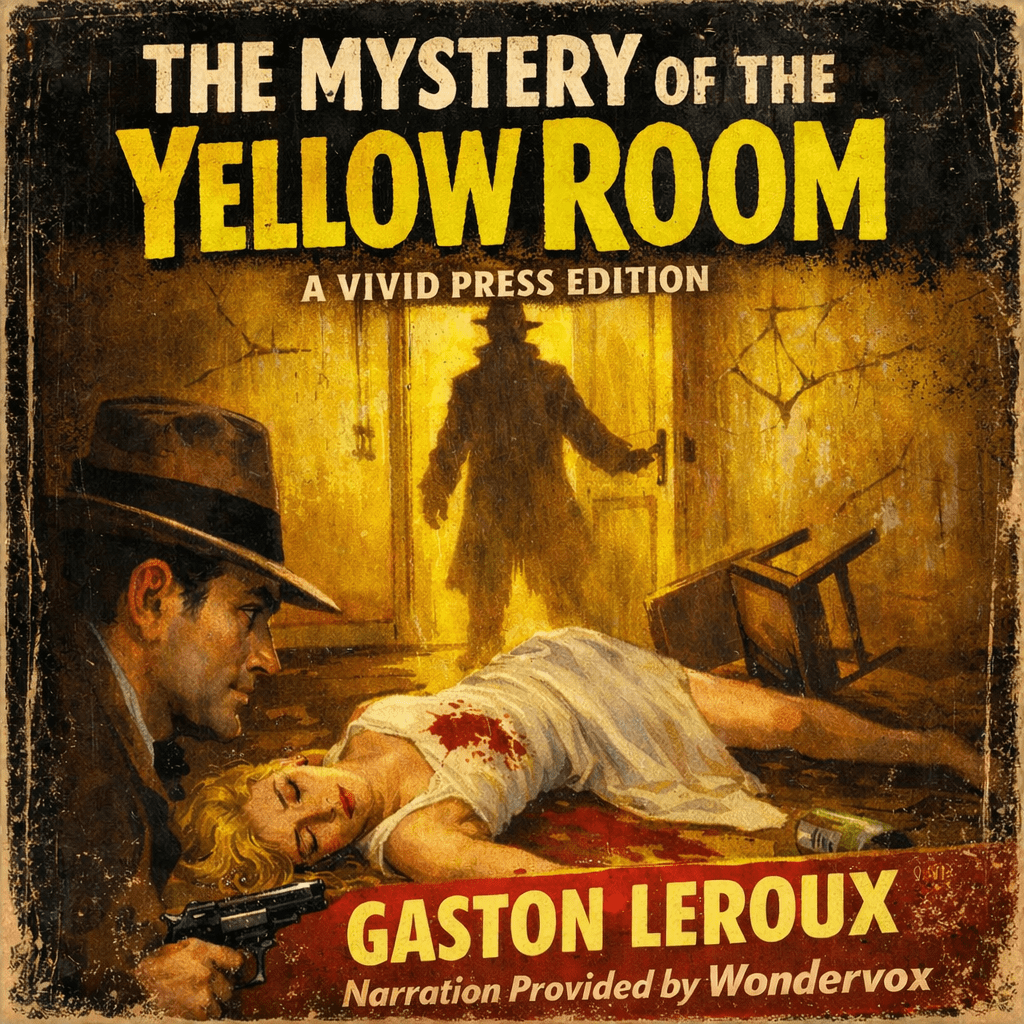
Mark McNease’s Fearsome Fiction Podcast: Genre Classic ‘The Mystery of the Yellow Room’ by Gaston Leroux (Chapters 11 – 13)
Welcome to Fearsome Fiction, the podcast that brings you mysteries, thrillers, rare gems, and a weekly True Crime Tuesday.
Today we continue our journey through one of the greatest locked-room mysteries ever written. Published in 1907, Gaston Leroux’s The Mystery of the Yellow Room set the standard for a genre that would captivate readers for generations. A young woman is found brutally attacked inside a room locked from the inside. No one could have entered. No one could have escaped. And yet someone did both. Following the investigation is the brilliant young journalist and amateur detective Joseph Rouletabille — one of fiction’s most ingenious and overlooked heroes — as he unravels a mystery that seems to defy every law of logic and nature. Now for your listening pleasure, another three chapters of Gaston Leroux’s ‘The Mystery of the Yellow Room.’
-
LGBT Senior’s Tech Talk: Video Calling for People Who Hate Video Calling
Video Calling for People Who Hate Video Calling
I’ll admit to having come into the video calling age with great reluctance. I’m not really a video person to begin with – the idea of scrolling through video after video looking for more amusement just doesn’t appeal to me – and feeling forced to Zoom and Skype (before its demise) and Facetime and all of it was unpleasant. But COVID hit and isolation set it. Suddenly we were dragged into the world of telehealth calls and working from home if that was at all possible. Then I started offering writing workshops, and video became very important to me.
Now I Zoom frequently and like it. I record my weekly co-hosts Twist Podcast on Zoom, and I’ve conducted a number of workshops that way. Having people take a workshop when they live in California or Spain isn’t exactly doable without video.
A lot of us came to video calling late and under that kind of duress. Many of us are still not sure if it’s something we want to use to our benefit, or something to endure.
If you’re in the latter camp, here’s the thing — video calling is almost always awkward at first, and then it isn’t. The trick is lowering the barrier to entry as much as possible.
Start with FaceTime if you have an iPhone and so does the person you’re calling. It’s the simplest option — one button, no account required beyond your Apple ID, and the quality is excellent. For Android users, Google Meet comes pre-installed on most phones and works just as cleanly.
Zoom is worth learning if you want to join group calls or community events, which are increasingly hosted there. The free version is more than adequate for personal use. Download it, create a free account, and practice with a friend or family member before you need it for anything important.
A few things that make video calling easier: prop your phone or tablet up rather than holding it, so your hands are free and the camera is at eye level. Good lighting matters more than you’d think — face a window or a lamp rather than having light behind you. And don’t worry about looking directly at the camera. Most people look at the screen, which is fine.
The discomfort fades faster than you’d expect. And seeing someone’s face — really seeing it — turns out to matter more than most of us realized before we had to go without it.
-
‘The Gospel According to God’ from ‘5 of a Kind: Short Fiction’ by Mark McNease (AUDIO)
CLICK THE PLAYER OR HERE TO LISTEN
I’ll be sharing one story at a time in audio version from my collection ‘5 of a Kind: Short Fiction.’
“The Gospel According to God”, narrated by my own Wondervox, is the first story the collection. Spanning human history from primordial silence to a chance encounter on a Central Park bench, the story traces what happens when people mistake the infinite for a brick and the boundless for a rulebook — including Eric, a pre-literate mystic who discovers the divine lives inside every person and is killed for saying so.
Threading through the ancient scenes is Melissa, a young theater major from Michigan who arrives in New York City chasing a dream and finds herself ambushed by wonder. Riding subways and navigating the beautiful chaos of the city, she begins to sense something watching back — curious and unhurried.
-
LGBT Senior’s News on the Positive Side- by Cora Berke: Hungary Comes Through
Cora Berke News on the Positive Side- by Cora Berke
“Each one of us matters, has a role to play, and makes a difference.”- Jane Goodall
On April 21, 2026, the European Union’s top court in Luxembourg ruled against Hungary’s anti- LGBTQ+ rules, making this the first move toward equality since 2021. Supported by 15 countries and the European Parliament, the court said,” We welcome today’s landmark ruling judgment of the court. This is the first time that the court finds such a violation of a key treaty provision on the EU values.”
The Fidesz-Hungarian Civic Alliance, under Prime Minister Viktor Orban, enacted this legislation in 2021, banning children from accessing LGBTQ+ content. The high court in Luxembourg argued that this was a shame and extended beyond to discriminating against the entire LGBTQ+ community. Pride Parades were banned and police were able to use face-recognition cameras for those in attendance. LGBTQ+ books, films and theater performances were also banned, all under the guise of protecting children.
The court stated, “Hungary has significantly deviated from the model of a constitutional democracy based on a value judgment that homosexual and non-cisgender life is not of equal value or status as heterosexual and cisgender life.”
-
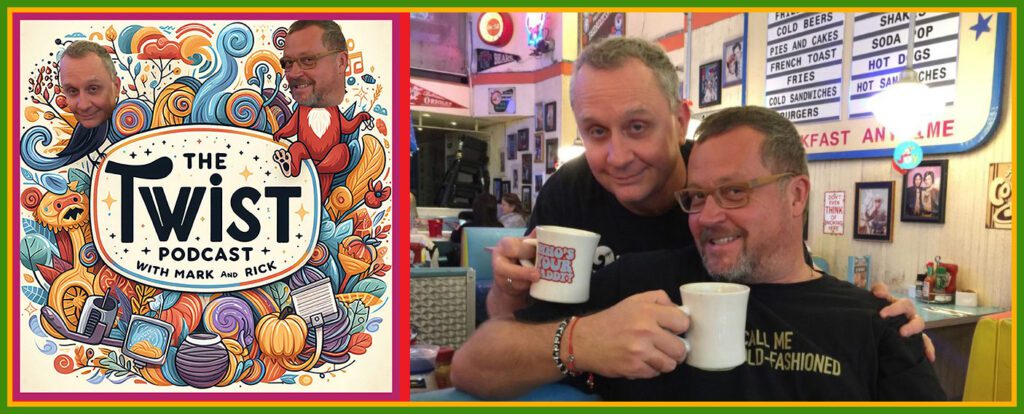
The Twist Podcast 326: Luggage Cart Wars, Rick Joins Substack, and An Interview with Angela Luna
Welcome to The Twist, episode 326. We have a packed show for you today. The luggage cart wars are real — we’re talking about the unspoken battlefield of airports and hotels where perfectly reasonable people turn into territorial strangers over a metal cart on wheels. Rick Rose has officially joined Substack, and we’ll get into what drove that decision and what he’s planning to do with it. We also have a terrific interview with Angela Luna that covers some real ground.
Beyond that, it’s a full episode — we get into what’s been bugging us this week, because there is always something. We have our Hit List recommendations, the things we’ve been watching, reading, eating, and generally can’t stop talking about. And Jo stops by with her weekly wisdom, because every episode needs a little Jo.
All of that on episode 326 of The Twist.
-
Editor’s Thoughts: AI and the End of Talent
AI and the End of Talent
By Mark McNease / EditorHaving been given something I know was written by AI and asked what I thought of it, as if the person had written it themself, and responding with “That’s very well written,” I realized that the end of talent – the years of development, the craft, the skill, that unique something that makes a writer a truly good writer – may be upon us. I know a lot of what I read now online is not written by humans, but it’s only recently that I viewed it from the perspective of someone who has been writing for 55 years and who has always enjoyed the thrill of discovering someone who was truly gifted), and realizing that AI is getting so good that it can make talent obsolete.
I’m not a hater. I use Claude, and find it very helpful when I’m stuck on plot, or I need to figure out a transition. But there is a not-so-fine line that, when crossed, makes decades of learning and growing and honing and crafting almost pointless. And that, I think, is the true imposter syndrome: not to believe that we are writers when we’re not, but to believe we are good ones when all we have written are prompts. I started writing at the age of 10 because it was and remains a magical experience, a zone of imagination that requires skill and time and effort and finesse and revision and listening and more revision and the silence of the blank page. To find ourselves approaching a point where “anyone can do that” with ChatGPT or Claude makes it all nearly pointless. I still want to thrill to the discovery of a wordsmith and a talented writer, without wondering if they actually wrote it. Will I stop using AI as a tool? No. Will I let it make me irrelevant? I hope not.
-
LGBT Senior Featured Essay: A Rose By Any Other Name, by Rick Rose
A ROSE BY ANY OTHER NAME WOULD SMELL AS SWEET
By Rick RoseShakespeare knew something about names. In Romeo and Juliet, Juliet argues that a name is just a label — that the thing itself is what matters.
Names matter enormously. They stick. They follow you into every room, every relationship, every first impression for the rest of your life. And the decision to give someone a name — that tiny human with no say in the matter — is one of the most consequential decisions a parent will ever make.
No pressure.
Certainly, popular names have their appeal and are easy. The Jennifers. The Michaels. The Emmas and the Liams. Share the name with me, and I will often know your age. These are safely field-tested, tried and true so much that they recycle and resurface every few generations. But there’s another school of thought — that a name should feel like your name. Something that landed in your gut and felt true.