-
New Your Write Path Promotional Video
-
The Twist Podcast 328: Lincoln Memorial Kiddie Pool, Praise for Penzeys, and What Bugs Us This Week
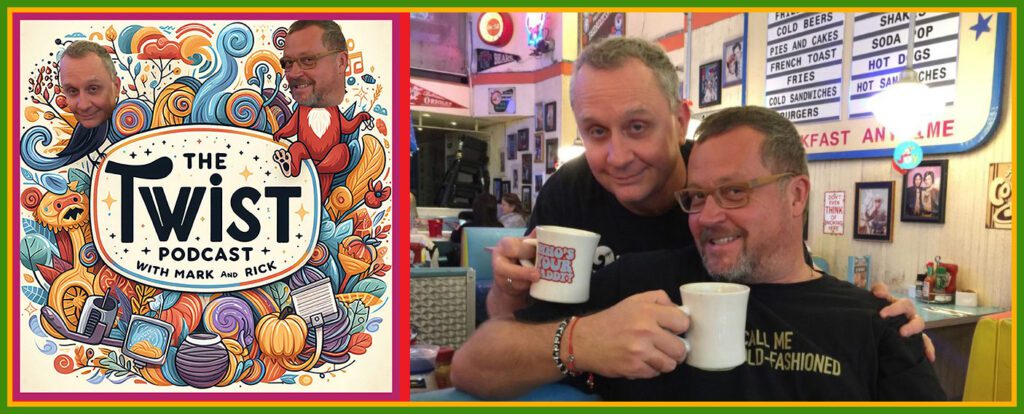
On further reflection, this week Mark and Rick do cannonballs into Trump’s giant kiddie pool, sing the praises of Penzeys super-progressive spice empire, and sound off on what bugs us this week.
-
LGBT Senior’s Tech Talk: Streaming TV Made Simple

Mark McNease/Editor
We cut the cord several years ago after holding onto cable out of a common fear that giving it up would bring calamity. But as the rates kept rising year after year, and we lost everything that had been recorded on the cable’s DVR when the box went bad, we said enough and made the switch to streaming.
We love it! Our main source is YouTubeTV, which has as many channels as cable did, and can record hundreds of hours of TV shows we don’t watch live. (Recording also means we can speed through any commercials.) And with streaming, it’s all connected to your account and not a cable box. Instead if having to pay extra for a second box in the bedroom, or even a third, all you need is a TV, WiFi, and an account with any of the streaming services.
Not only does this mean our TV essentially goes with us anywhere, and can be streamed on any device, it also means I can travel with my Amazon Fire stick, plug it into a hotel room’s TV, and see everything we’d see at home. On that note, too, I recently discovered Hampton Inns are now making streaming the default, either through in-house apps or with the ability to connect your own device. Smart move! Hotels don’t have to pay a cable fee for their room TVs now, they just need streaming apps. It’s about time!
So, if you’ve cut the cord on cable, or you’re thinking about it, welcome to the wonderful, sometimes bewildering world of streaming television. There’s never been more to watch. There’s also never been more ways to accidentally spend $80 a month on services you forgot you signed up for, so let’s fix that.
What Is Streaming, Exactly?
Streaming means watching TV shows, movies, and video content over the internet instead of through a cable or satellite provider. No dish, no cable box, no appointment window between noon and four. You watch what you want, when you want, on your TV, tablet, phone, or computer. The tradeoff is that instead of one big cable bill, you’re now managing several smaller subscriptions — and that’s where things can quietly get out of hand.
-
New Workshop Scheduled: A Thematic Journaling Workshop for Gay Men 60+ (June 24)
A Thematic Journaling Workshop for Gay Men 60+
Here’s something people don’t often mention about getting older: the more life we’ve lived, the more interesting we become.
The places we’ve lived, the people we’ve loved, the versions of yourselves we’ve tried on and kept or discarded. It’s all there in the tapestry of our lives.
This journaling workshop is a place for rediscovery through journaling. No experience required, no literary ambitions necessary. Just a willingness to follow some simple good prompt, and see what comes out when we explore ourselves.
We’ll write together, share if we feel like it, and leave with more pages than we arrived with.
What to expect: A warm, low-pressure Zoom session with short writing exercises, optional sharing, and a take-home prompt to keep the momentum going.
Who it’s for: Gay men 60 and older — whether you’ve never kept a journal or you used to and stopped.
Led by Mark McNease, certified Guided Autobiography Instructor and author of fifteen novels, who believes everyone in the room has a story worth writing.
-
LGBT Senior’s Podcast Pick: UNCLOSETED with Spencer Macnaughton – How America’s Foster System Is Failing Trans Kids (YouTube)
-
Mark McNease’s Fearsome Fiction Podcast: Night Flight to Murder Town – A Marshall James Thriller (Chapters 28 – 30)
In these three chapters of Night Flight to Murder Town, Marshall James finds himself waking up on the couch of Colin Griffin — a sharp-witted escort who becomes his unlikely confidant — and paying the price of admission: the truth. Marshall lays out his history, from his Hollywood past to the body he found that morning, and Colin listens without calling the police. Meanwhile, in a counterpoint chapter set in the present, Marshall and his partner Boo enjoy a deceptively quiet afternoon in Lambertville and New Hope — a brief, tender interlude that feels worlds away from what’s unfolding in New York City.
Back in the past, the stakes suddenly escalate. A breaking news report out of Manhattan reveals that Senator Daniel Roth — the powerful man Trent Stoffer had been secretly involved with — has fallen twelve stories to his death from his apartment near the United Nations. With his old flame dead and a senator now gone, Marshall grows convinced that his presence in New York is no accident. He’s been here before — marked as a patsy, caught in someone else’s design. And so he does what Marshall James always does: he heads straight for the scene of the crime.
-
Savvy Senior: Still Working at 65? Here’s How to Handle Medicare
By Jim Miller
Dear Savvy Senior,
My wife and I are approaching 65, but I’m still working and have good health coverage through my employer. Do we need to enroll in Medicare at this point?
–Almost 65
Dear Almost,
If you or your spouse is still working past age 65 and have health insurance through your job, you may be able to delay enrolling in Medicare without a late enrollment penalty. However, the rules depend largely on the size of your employer.
First, a quick refresher: Remember that original Medicare has two parts. Part A, which covers hospital care and is premium-free for most people. And Part B, which covers doctor visits, lab tests, and outpatient care and has a monthly premium of $202.90 in 2026. Higher-income individuals (over $109,000) and couples (over $218,000) pay more.
If you’re already receiving Social Security, you’ll automatically be enrolled in Parts A and B when you turn 65, and your Medicare card will arrive in the mail. It will include instructions on how to return it if you have employer coverage that allows you to delay Part B.
-
LGBT Senior’s News On the Positive Side with Cora Berke
Cora Berke News on the Positive Side- by Cora Berke
Texas Patrons Rally to Save Gay Bar
“Alone we can do so little, together, we can do so much.” -Helen Keller
Galveston Texas, also known as “The Queen City of the Gulf”, is a barrier island on the Gulf Coast of Texas. During the 19th. century it was a major port and haven for Caribbean pirates. One such pirate was Jean Lafitte, who started a colony in Galveston in 1817. Among the many romantic pirate tales, his name remains legendary and some believe there is still buried treasure on the island.
It is no wonder that when Cal LeBlanc opened a bar in Galveston in 1965, he named it “Lafitte’s”. Five years later the bar was sold to Robert Mainor who changed the name to “Robert’s Lafitte” and welcomed the LGBTQ+ community in honor of Stonewall. Robert Mainor passed away in 2022. The bar has been a mainstay in Galveston and is the oldest gay bar in Texas.
Fast forward to May 2026. An inspection of the bar revealed that it was not up to current city codes. The bar, ceiling and plumbing were cited for violations and given 30 days to either be repaired or Robert’s Lafitte would be closed.
Terry Fuller, bartender and events coordinator said, “They’re things that cost quite a bit of money. Robert’s Lafitte has always been a mixed crowd, gay, straight, bi, trans, people of all walks of life. It’s the oldest continuously running gay bar in Texas, and there’s so much rich history.”
-
Mark McNease’s Fearsome Fiction Special Edition: Short Story ‘Jawbone’ from 5 of a Kind
Today in this special feature of the Fearsome Fiction Podcast we’re offering another short story from Mark McNease’s collection, ‘Five of a Kind.’
Jawbone tells the story of young Richard who was eighteen years old when a head-on collision on a snowy Indiana road took the lower half of his face. He survived — and that, in many ways, was the cruelest part.
We Richard Krump across the decades after his accident: the surgeries that promised normalcy and delivered nothing, the friends who never showed up to his homecoming party, the little girl in a drugstore who gave him his name, and the slow, steady retreat of everyone he ever loved — until only his books, his silence, and finally his paintings remained.
A haunting, deeply human story about disfigurement, isolation, and the particular cruelty of surviving intact on the inside while the world refuses to see past the outside. Jawbone begins where a young man’s life as he knew it ends.
-
True Crime Tuesdays – A Fearsome Fiction Feature: Shot By a Killer Clown
True Crime Tuesdays — A Fearsome Fiction Feature: Shot by a Killer Clown
It was Memorial Day weekend, 1990, in Wellington, Florida. Marlene Warren answered her front door to find a clown holding flowers and balloons — and was shot in the face at point-blank range. The clown got back in the car and drove away. Marlene died two days later.
The case had a suspect almost immediately. It had circumstantial evidence. It had motive. What it didn’t have — for twenty-seven years — was enough to make an arrest. This week on True Crime Tuesdays, we follow one of the most bizarre cold cases in American history from a quiet Florida neighborhood in 1990 all the way to a courthouse in 2023, and a prison release that left a victim’s family without the justice they deserved.
Fearsome Fiction is produced by MadeMark Media. New episodes every Tuesday.