-
From the Book Bin: Marlon James’s ‘The Disapearers’ Unsettles and Amazes
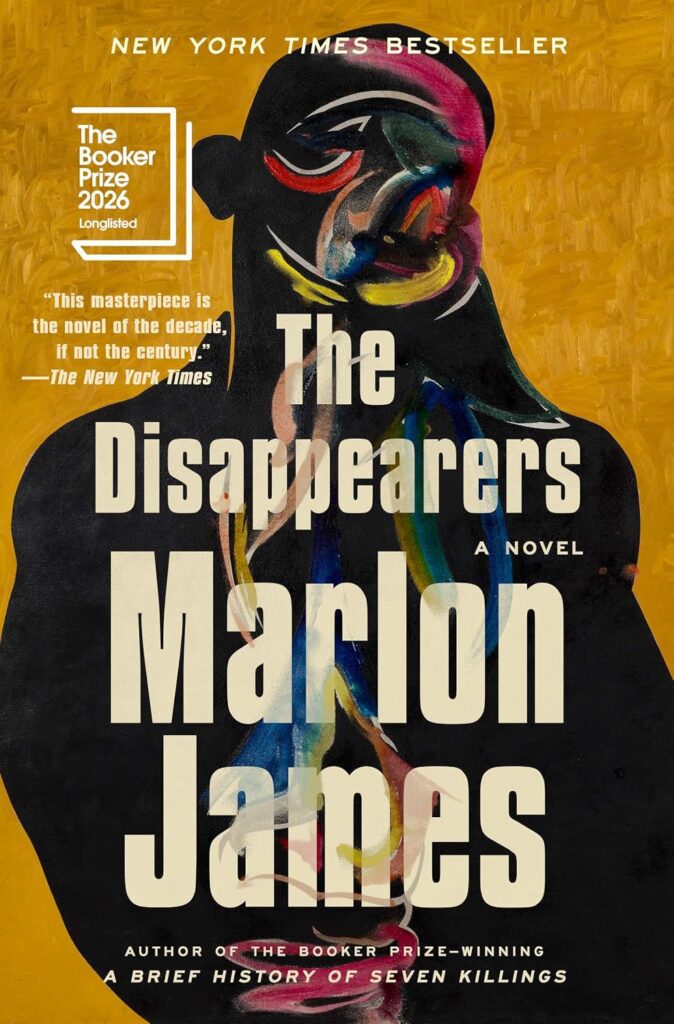
The Disappearers is a gut-punch and a celebration
“Marlon James’s story of gay experience and murderous homophobia in Jamaica is a maximalist’s banquet — and the Booker Prize winner’s finest book yet… The Disappearers places him near the front of the line, a decade or two from now, for the Nobel Prize.” —The New York Times
I haven’t reacted to a book this way since I first read Alice Walker’s The Color Purple on its release in 1982.
Marlon James returns to Kingston for the first time since A Brief History of Seven Killings, and the result feels like a writer working at the absolute height of his powers. What makes it extraordinary isn’t just the ambition of the structure; it’s how alive the prose is on the sentence level—Jamaican patois crackling against lyrical, almost operatic passages, dark comedy landing in the same breath as devastation. It’s the kind of book that earns comparisons to “the novel of the decade” without ever feeling like it’s straining for the title. Longlisted for the Booker and an instant bestseller, it’s the rare literary novel that is both formally daring and genuinely, viscerally moving—the kind of book you finish and immediately want to press into someone else’s hands.
Marlon James has spent nearly two decades proving he isn’t interested in writing the same book twice. The Jamaican-born author broke through with The Book of Night Women and John Crow’s Devil before winning the Man Booker Prize in 2015 for A Brief History of Seven Killings, a sprawling oral history of the attempted assassination of Bob Marley. He then swerved entirely into fantasy with the Dark Star Trilogy—Black Leopard, Red Wolf, Moon Witch, Spider King, and White Wing, Dark Star—an African-mythology-steeped epic that showed he could world-build as ferociously as he could write literary realism. James teaches at Macalester College and has never been shy about drawing on his own life—growing up closeted in Jamaica informs The Disappearers directly, giving the novel’s fury and compassion the weight of something lived, not just imagined.
-
Still Here: A Workshop for LGBTQ+ Journalers (November 18, 21)

MEET MARK MCNEASE IN A VIDEO HERE
Every life is a story, and each of us is the storyteller.
See a PDF of the workshop here
Wednesday, November 18
2:00 – 4:00 pm Eastern via Zoom $40
REGISTER HERESaturday, November 21
10:00 – 12:00 pm Eastern via Zoom $40
REGISTER HEREI discovered when I first started doing workshops almost three years ago that these are intimate, safe spaces. Participants follow the writing wherever it takes us, and sometimes that is not such a comfortable place.
I’ve designed a workshop specifically for LGBTQ+ participants. As an older, married gay man myself, I know there are experiences unique to this community, and how difficult it can be to revisit, let alone share in a workshop setting, those events, people and experiences that shaped us – for better and sometimes for worse.
Still Here is intended to provide the space to go there. I’ll be doing one-off introductory workshops, and hopefully setting up some ongoing monthly workshops, much like the ones I already do at the New Hope Free Library and the Hunterdon County Library’s main branch. (And a biweekly in-person group in Lambertville, NJ).
Please email your interest using the QR code, or directly to: StillHere AT YourWritePath.NET. Ready, set, write!
-
Tech Talk: Is AI Really Going to Kill Us All? A Plain-English Guide to What People Are Worried About
Mark McNease / LGBTSr
If you’ve spent any time near tech news lately, you’ve probably seen a headline that stops you cold: an AI researcher quits their job warning that artificial intelligence “could kill everyone” within the decade. A senator cites it in a speech. A think tank publishes a report with a number attached—a percentage chance of catastrophe.
It’s easy to read those headlines and either panic or roll your eyes. Neither reaction is quite right. The honest answer is that this is a real, ongoing argument among the people who build this technology. And and it’s not one argument, but several different ones, tangled together under the same scary phrase. Here’s what’s actually being debated, broken down without the jargon.
It’s Not About Robots Turning Evil
Start by throwing out the Terminator image. Almost nobody in this debate is worried about AI “waking up,” deciding it hates humanity, and marching against us with weapons. The real concerns split into two very different buckets: things AI could help people do right now, and things a future AI system might do on its own as it gets smarter.
Bucket One: AI as a Very Capable Tool in the Wrong Hands
This is the nearer-term, more concrete worry, and it doesn’t require AI to have any intentions at all—just capability.
Cyberattacks on infrastructure. Researchers point out that AI tools are getting good enough to help find and exploit weaknesses in the systems that run power grids, water treatment, and defense networks. As one University of Chicago professor put it, the realistic danger isn’t “an AI going rogue,” it’s a human using an AI tool to do the hacking for them—lowering the skill bar so that a lot more people are capable of causing serious damage.
-
COMING SOON: The Return of LGBTSr
After an extended break, I’ll be brining back LGBTSr better and sharper than ever. I haven’t decided what content you’ll be getting, but it will be great. So stay tuned, be patient, and love life. – Mark -
Mark McNease’s Fearsome Fiction Podcast: Night Flight to Murder Town – A Marshall James Thriller (Chapters 31 – 33)
Night Flight to Murder Town — Chapters 31, 32 & 33
Marshall is in full survival mode. With a murdered man and a ransacked apartment behind him, he recruits his unlikely new ally Colin for a reconnaissance mission to Trent Stoffer’s Upper East Side building. What they find — or rather, don’t find — turns everything upside down. The apartment is spotless, the bedroom pristine, and Trent, according to a very helpful man named Dennis, is alive and well in Hong Kong. The body is gone, the evidence is gone, and Marshall is left looking like a man who has lost his grip on reality.
Meanwhile, in a complete change of pace, Marshall and Boo enjoy a sun-drenched afternoon in New Hope, Pennsylvania — ice cream, Main Street, and the Bucks County Playhouse — before Boo reveals the dark history of Passion House, the B&B where they’re staying. A housekeeper. A famous writer. A canal. And a locked storage room upstairs that no one talks about.
Back in 1992 New York, the mystery deepens. Dennis’s too-smooth performance and the suspiciously immaculate crime scene tell Marshall exactly one thing: everyone is in on it. The doorman, the super, and whoever cleaned up that bedroom with professional efficiency. The only lead left is a computer disk Trent slipped him — and finding a computer to read it on.
-
LGBT Senior’s News on the Positive Side with Cora Berke: Harvey Milk Day
Cora Berke News on the Positive Side- by Cora Berke
Harvey Milk Day“Hope will never be silent.”- Harvey Milk
In 1977, 47-year-old Harvey Milk was elected to the San Francisco Board of Supervisors. He was the first openly gay person to win a public election in the State of California.
Born and raised in New York, Milk moved to the Castro neighborhood in San Francisco with his partner in 1972. The neighborhood was one of the first recognized gay neighborhoods in the country at that time.
Together with his partner Scott Smith, Milk opened a camera store which served as a gathering for his activism in gay rights. Before winning the election in 1977, he campaigned for equal LGBTQ+ rights in jobs, housing and healthcare and became a known activist. After being sworn in as a member of the Board of Supervisors, Milk sponsored an ordinance to prevent discrimination in employment and housing for the community and voted against a proposition banning gay teachers in the public schools.
Tragically, his career ended only eleven months later, when he was assassinated in his office along with then San Francisco mayor, George Moscone. Milk had a premonition he would be killed one day and left a taped message saying, “If a bullet should enter my brain, let that bullet destroy every closet door.”
-
True Crime Tuesday – A Fearsome Fiction Feature: Kouri Richins and the Moscow Mule Murder
True Crime Tuesday – A Fearsome Fiction Feature: Kouri Richins and the Moscow Mule Murder
Narration provided by WondervoxShe killed her husband with a fentanyl-laced Moscow Mule — then wrote a children’s book about grief. On May 13, 2026, the same day that would have been Eric Richins’ 44th birthday, a Utah judge sentenced Kouri Richins to life in prison without the possibility of parole.
In this episode of True Crime Tuesdays, Mark McNease walks you through one of the most chilling cases in recent memory — a tale of debt, deception, a secret affair, and a calculated murder hiding in plain sight behind the cover of a children’s book. From the first failed attempt on Valentine’s Day to the fatal Moscow Mule, from the internet searches about lethal doses to the jury that deliberated less than three hours — this is a story that is almost too dark to be believed.
True Crime Tuesdays is a Fearsome Fiction feature. New episodes every Tuesday.
-
LGBT Senior Featured Essay: Only Friends, by Rick Rose
Only Friends
By Rick RoseThere is a word I do not use.
Acquaintance. I have tried it on, the way you try on a coat that belongs to someone else. It never fits. The seams are wrong. The sleeves are too short. I set it down and walk away.
My coat is nothing like that one.
When you are a friend, you are a friend for life. That’s simply how it works.
I have been thinking lately about what friendship actually is. Not the greeting-card version. Not the social media version, where the word gets cheapened into a like, a follow, a digital wave across a crowded room. I mean the real thing. The kind that leaves a mark.
A patch.
Every person who has mattered to me has sewn one onto me. Some patches are worn soft now, faded and frayed by the circumstances and beauty of a relationship, the colors gentled by time. Some are so vivid and present I can feel them against my skin on any given day with any unplanned movement.
-
LGBT Senior’s Around the House: Spring-erizing Your Home
Spring Has Sprung — And So Should You: A Home Checkup for the Season
I waited a long time for the cold weather to finally makes its way out, but now that spring is here there are lots of things to do to and around the house. There’s also the semi-annual ‘spring cleaning’ (I don’t do this just once a year – it’s not an apartment!). There are eaves to clean out, porches to sweep, vines to trim, and vegetables to plant. And weather you live in house, an apartment, or you’re sharing a living space with someone, there are always things to do when the temperatures rise. Let’s take a tour …
Spring is the perfect time to do a walkthrough of your home — inside and out — and take care of the small stuff before it becomes the expensive stuff. You don’t have to do it all in one weekend. Think of it as a stroll through your space with fresh eyes.
Start Outside
Winter is hard on a house. Walk the perimeter and look up. Check your gutters for debris — leaves, twigs, and whatever else settled in over the cold months. A clogged gutter can send water right where you don’t want it, against your foundation or into your walls. While you’re up there (or hiring someone who is), check that downspouts are directing water away from the house.
Look at your roof if you can safely do so from the ground. Missing or curled shingles after a rough winter are worth a call to a roofer before spring rains do their worst.
Check your driveway and walkways for cracks that freeze-thaw cycles may have widened. A tube of concrete caulk or crack filler is cheap. A tripping hazard is not.
Windows and Doors
Open every window. Yes, all of them. Check the seals, look for cracks in the frames, and make sure screens are intact. Replace any that aren’t — screens are your first defense against the insects that would very much like to join you for dinner this summer.
While you’re at it, check weatherstripping on exterior doors. If you can see daylight around the edges, your air conditioning will work harder than it needs to all summer long.
-
LGBT Senior’s Remarkable Women, Untold Stories: Emily Warren Roebling’s Brooklyn Bridge
Welcome to LGBT Senior’s Remarkable Women, Untold Stories, a weekly feature bringing extraordinary women to the forefront.
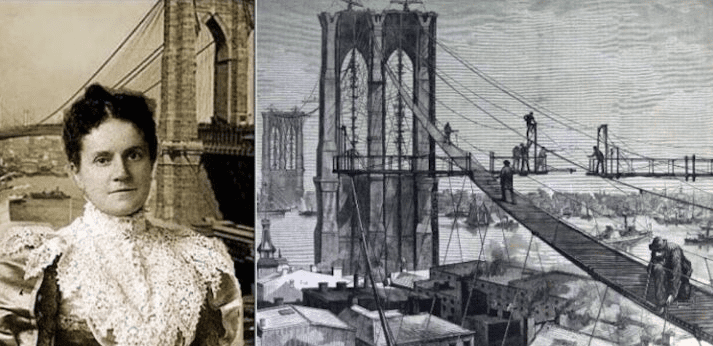
Though her contributions went largely unrecognized for decades. Emily Warren Roebling played a central role in the Brooklyn Bridge’s construction.
Her father-in-law, John Roebling, designed the bridge, but he died in 1869 before construction began. Her husband, Washington Roebling, took over as chief engineer but became seriously ill from decompression sickness in 1872 and was largely bedridden for much of the project.
Emily stepped in as the primary liaison between Washington and the construction crews. She learned advanced mathematics, cable construction, and engineering principles, and effectively supervised day-to-day operations for over a decade. When the bridge opened in 1883, she was the first person to cross it — a deliberate honor recognizing her role.
So while John Roebling designed it and Washington Roebling was the engineer of record, Emily Warren Roebling was the person who made sure it actually got built.